If you have started researching a Kenya safari and found yourself wondering about visas, you are not alone, and you are asking the right question at the right time. Kenya’s old visa-on-arrival system is gone. Since January 2024, virtually all international tourists must apply for an Electronic Travel Authorisation (eTA) online before they board a single flight.
The good news? The Kenya eTA process is genuinely straightforward when you know what to expect. You apply online, upload a few documents, pay a modest fee, and receive your approval by email, usually within three working days. The mistake most first-timers make is leaving it too late, or stumbling onto unofficial third-party websites that charge two or three times the official rate.
At Mouti Tours, we help our safari clients navigate the eTA process every week. This guide covers everything you need to know (requirements, cost, step-by-step application, and how to time your eTA alongside your safari booking) so you can arrive in Kenya prepared, legal, and ready for the adventure.
| Quick Answer: Kenya eTA at a Glance |
| ✓ The Kenya eTA is an Electronic Travel Authorisation; it replaced the old visa on arrival system and must be obtained online before you travel. |
| ✓ Virtually all international tourists now require a Kenya eTA, including travellers from the USA, UK, Canada, Australia, and EU countries. |
| ✓ The application fee is USD 34.07 per person, payable by credit or debit card through the official government portal. |
| ✓ Apply at etakenya.go.ke, the only official application portal. Avoid third-party sites that charge significantly more. |
| ✓ Processing typically takes around 3 working days. The official advice is to apply at least 2 weeks before your travel date. |
| ✓ The Kenya eTA grants a single entry and allows a stay of up to 90 days for tourism, safari, and visiting friends or family. |
What Is the Kenya eTA; and What Happened to the Visa on Arrival?
For many years, Kenya offered a simple visa on arrival at Jomo Kenyatta International Airport in Nairobi and other major entry points. You joined a queue, handed over your passport and USD 50, and walked away with a visa sticker in your passport. It was convenient but slow (immigration queues could stretch for hours during peak arrivals), and it gave travellers no certainty before they boarded their flights.
Kenya replaced this system with the Electronic Travel Authorisation (eTA) as part of a broader modernisation of the country’s border management. The eTA is a digital pre-approval linked directly to your passport. There is no visa sticker, no queue for a separate visa desk, and no cash payment on arrival. When your eTA is approved, the clearance is electronic; immigration officers verify it digitally when you arrive.
The system went fully live for international tourists in January 2024. If you arrive without a valid, approved eTA, you will be denied boarding at your departure airport or turned away at Kenyan immigration. There are no exceptions for forgetting or for claiming you did not know; airlines check eTA status before you board.
The comparison table below shows how the eTA differs from the old system:
| Feature | Old Visa on Arrival | Kenya eTA (Current) |
| Where to apply | At the airport immigration desk | Online at etakenya.go.ke before travel |
| Processing time | Immediate (on arrival) | Approx. 3 working days |
| Cost | USD 50 | USD 34.07 |
| Documentation | Minimal (passport + cash) | More complete (photo, accommodation proof, onward ticket) |
| Immigration queues | Often long at busy arrivals | Faster e-gate processing for approved eTA holders |
| Uncertainty on arrival | Could be denied at the desk | Pre-approved; no surprises at the airport |
Who Needs a Kenya eTA?
The short answer is: if you hold a passport from outside the East African Community (EAC), you need a Kenya eTA. This includes travellers from the USA, UK, Canada, Australia, all EU member states, India, China, South Africa, the UAE, and every other non-EAC country.
The only travellers currently exempt from the eTA requirement are nationals of EAC member states; Uganda, Tanzania, Rwanda, Burundi, South Sudan, and the Democratic Republic of Congo. These travellers benefit from free movement rights within the EAC bloc.
| Traveller Nationality | eTA Required? |
| USA, UK, Canada, Australia | Yes |
| EU / Schengen countries | Yes |
| India, China, UAE | Yes |
| EAC nationals (Uganda, Tanzania, Rwanda, Burundi, South Sudan, DRC) | No – free movement within the EAC |
| Diplomatic passport holders (select countries) | Check with Kenya High Commission |
If you hold dual nationality, you can choose which passport to use. If one of your passports is from an EAC member state, you may enter without an eTA on that document. If you are unsure, always check the current entry requirements with the Kenya Immigration Service or your nearest Kenya High Commission before travel, as policies can change.
Kenya eTA Requirements: What You Need Before You Apply
Before you open the application portal, gather the following. Having everything ready before you start means you can complete the application in one sitting, typically 15 to 20 minutes.
| Document / Requirement | Details |
| Passport | Valid for at least 6 months beyond your intended departure date from Kenya |
| Return / onward flight ticket | Proof that you are leaving Kenya; a booked flight confirmation is sufficient |
| Proof of accommodation | Hotel booking, safari lodge confirmation, or a signed letter from a host in Kenya |
| Digital passport photo | Recent, white background, passport-style; must meet the portal’s size and format requirements |
| Yellow fever certificate | Required only if arriving from a yellow fever endemic country; advisable if transiting through one |
| Payment card | Credit or debit card to pay the USD 34.07 application fee |
A Note on Accommodation Proof
This is the requirement that catches the most people off guard. You need proof of where you will be staying in Kenya before your eTA can be approved. If you are booking a safari with Mouti Tours, your safari lodge confirmations and itinerary documents serve as your accommodation proof, and we send these to all confirmed clients well in advance. If you are planning a self-drive safari or independent trip, make sure your hotel and lodge bookings are confirmed and downloadable before you apply. Learn more about how we handle this in our guide to how to plan a Kenya safari.
How to Apply for a Kenya eTA: Step by Step
The official application portal is etakenya.go.ke. Use only this site. Do not use any other website; there are many unofficial third-party platforms that mimic the look of the official portal and charge two to three times the legitimate fee, with no guarantee of accuracy or support.
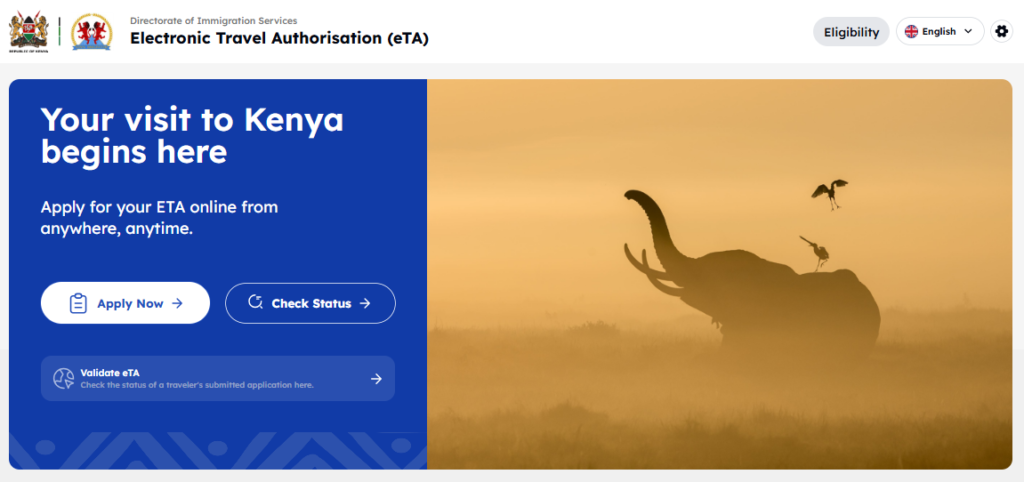
Here is the complete application process:
- Go to etakenya.go.ke and create an account using your email address. If you have applied before, log in with your existing credentials.
- Complete the application form. You will be asked for personal details (name, date of birth, nationality, passport number and expiry date), your intended travel dates, your point of entry into Kenya, and your purpose of visit.
- Upload your required documents: passport data page, digital passport photo, return or onward flight confirmation, and proof of accommodation.
- If you are arriving from a yellow fever endemic country, upload your yellow fever vaccination certificate at this stage.
- Review your application carefully before submitting. Errors in passport numbers or travel dates are a common cause of delays.
- Pay the application fee of USD 34.07 by credit or debit card. You will receive an immediate payment confirmation.
- You will receive an acknowledgement email confirming your application has been received. Keep this email.
- Monitor the status of your application through the portal. You can log in at any time to check progress.
- Once approved (typically within 3 working days) you will receive your eTA approval letter by email. Download it immediately and save it in multiple places (cloud storage, email, phone camera roll).
- Print a physical copy of your eTA approval to carry alongside your passport. Digital copies are useful, but do not rely solely on them in areas with poor mobile signal.
Important: apply using one portal session if possible. Incomplete applications that are abandoned and restarted can occasionally cause duplicate records, which slows processing. If you need to pause, save your progress through the portal’s draft-saving function rather than starting again.
Kenya eTA Cost and Payment
The Kenya eTA fee is USD 34.07 per person. This is the official government rate payable through the etakenya.go.ke portal. Payment is accepted by credit card or debit card; Visa, Mastercard, and American Express are all accepted.
EAC nationals who are required to obtain any entry document are subject to different fee structures; check the portal for current rates applicable to your specific nationality.
Watch Out for Third-Party Sites
Search for “Kenya eTA application”, and you will find dozens of websites that are not the official government portal. These sites typically charge USD 70–150 or more per person for what is a USD 34.07 process. Some offer “expedited processing”, but the processing timeline is set by Kenya Immigration, not by any third-party service. There is no faster track available through unofficial channels.
Always apply directly through etakenya.go.ke. Bookmark the URL before you start, and double-check the address bar before entering any personal or payment details.
How Long Does the Kenya eTA Take to Process?
In our experience working with clients across dozens of nationalities, Kenya eTA applications are typically processed within 3 working days. Many are approved within 24 to 48 hours. That said, the Kenya Immigration Service does not guarantee a specific timeline, and processing times can extend during peak travel periods or public holidays.
The official government guidance recommends applying at least 72 hours before travel. At Mouti Tours, we advise all our safari clients to apply a minimum of two to three weeks before their departure date. Here is why that matters in practice:
- If your application is returned for additional information or a document re-upload, you have time to fix it without panic.
- If processing delays do occur during a busy period, you still have a comfortable buffer.
- Some airlines check eTA status during online check-in, which opens 24 to 48 hours before departure. Applying at the last minute creates real risk of being unable to check in.
- You can use your eTA approval document as part of your accommodation proof when booking tours and transfers, which helps the rest of your planning move faster.
What to Do If Your eTA Is Delayed
If you have not received an update within five working days, log back into your account on the portal and check your application status. If the status shows “pending” and no communication has been received, use the portal’s official contact function to follow up. You can also reach out to the Kenya High Commission or Embassy in your home country for assistance.
Do not cancel your application and re-apply; this creates a duplicate record and can cause further delays. Follow up through the official channels and document your communication in case you need to show an airline that your application is in progress.
What the Kenya eTA Allows: Entry Conditions and Length of Stay
The standard Kenya eTA issued for tourism and safari travel is a single-entry authorisation. Here is what that means in practice:
- Single entry: once you leave Kenya, your eTA is used. You cannot re-enter on the same eTA. If your itinerary includes a side trip to Tanzania or Uganda and a return to Kenya, you would need to factor this in, either by applying for a separate entry permit or planning your movements accordingly.
- 90-day maximum stay: you may remain in Kenya for up to 90 days from the date of entry. For almost all safari travellers, this is far more than sufficient.
- Permitted purposes: tourism, safari, visiting friends and family, and transit. The eTA is not valid for employment, paid work, or study.
- No conversion to work permit: you cannot convert an eTA into a work permit from within Kenya. This is an important distinction for anyone considering a longer stay for non-tourism purposes.
Can You Extend Your Stay Beyond 90 Days?
Extensions beyond 90 days are possible through Kenya’s Department of Immigration Services, but they require a formal application, documentation of your reason for extending, and approval from Kenyan authorities. For the vast majority of safari visitors, the 90-day allowance is more than adequate. If you are planning an extended stay, consult the Kenya Immigration Service website or contact Mouti Tours for guidance on the appropriate visa category.
Yellow Fever Certificate: Do You Need One for Kenya?
Yellow fever vaccination is not universally required for entry into Kenya, but the rules depend on where you are travelling from.
When a Yellow Fever Certificate Is Required
You must present a valid yellow fever vaccination certificate (the International Certificate of Vaccination or Prophylaxis, also called the “yellow card”) if you are arriving in Kenya from a country where yellow fever transmission is endemic. The main endemic regions include:
- Sub-Saharan Africa: Angola, Cameroon, Central African Republic, Chad, Republic of Congo, Democratic Republic of Congo, Ethiopia, Gabon, Guinea, Ivory Coast, Mali, Niger, Nigeria, Senegal, Sierra Leone, and others.
- South America: Bolivia, Brazil, Colombia, Ecuador, Peru, Venezuela, and others.
When a Certificate Is Advisable but Not Strictly Required
If you are travelling from the USA, UK, Canada, Australia, or most of Europe (where yellow fever is not endemic), you are not required to show a certificate on arrival in Kenya. However, if your travel itinerary includes a transit through an endemic country (even a brief layover), it is strongly advisable to carry your certificate. Some airlines and border officials apply the rule broadly.

The yellow fever vaccine is given as a single dose and provides lifelong protection. If you are planning a Kenya safari and have not been vaccinated, visit a travel health clinic at least 10 to 14 days before departure to allow the vaccine time to take effect. Many clinics can also advise on malaria prevention medication, which is a separate and equally important consideration for all Kenya safari visitors.
Common Kenya eTA Mistakes to Avoid
These are the errors we see most often, and the ones that cause the most stress. All of them are entirely avoidable.
- Applying too close to your departure date. Three working days is the typical processing time, but it is not guaranteed. Apply two to three weeks out, not two to three days.
- Using unofficial third-party websites. These platforms charge significantly more than the official fee and offer no additional service. Always use etakenya.go.ke.
- Uploading a poor-quality or incorrectly sized passport photo. The portal has specific requirements for photo dimensions and background colour. A blurry or non-compliant photo is one of the most common reasons for application rejection.
- Not checking passport validity. Your passport must be valid for at least six months beyond your intended departure date from Kenya. Many travellers realise their passport is expiring only when they try to submit their eTA application.
- Not having accommodation proof ready. You cannot complete the application without this. Confirm your lodge or hotel bookings before you start the eTA process.
- Not downloading the approval document before departure. Your eTA is electronic, but you should carry a downloaded PDF and a printed copy. Do not rely on internet access in the airport queue.
- Checking spam after applying. The eTA acknowledgement and approval emails sometimes land in spam or promotions folders. Add the portal’s email address to your safe senders list as soon as you apply.
- Entering incorrect passport details. A single-digit error in your passport number will cause a rejection. Read the data page of your passport carefully and double-check every field before submitting.
Kenya eTA and Safari Planning: Getting the Sequence Right
One of the most practical questions our clients ask is: should I apply for the eTA before or after I book my safari? The answer is: book your safari first, then apply for the eTA immediately afterwards.
Here is why the sequence matters. Your eTA application requires proof of accommodation in Kenya, which means confirmed lodge bookings. The most reliable accommodation proof you can use is a confirmed safari itinerary from a registered tour operator. When you book a safari with Mouti Tours, we provide a full written itinerary with lodge confirmation details, which you can use directly in your eTA application.
The recommended sequence for Kenya safari travel planning is:
- Decide on your travel dates, preferred parks, and safari style (budget camping, lodge safari, luxury, beach extension).
- Apply for your Kenya eTA at etakenya.go.ke using your confirmed itinerary as accommodation proof.
- Sort your travel insurance; make sure it includes emergency medical evacuation cover, which is essential for remote safari areas.
- Check your yellow fever vaccination status and book a travel health appointment for malaria prevention advice.
- Confirm all your document copies (passport, eTA approval, insurance, and yellow fever certificate if applicable) are saved digitally and in hard copy.
Understanding the full cost of your safari before committing is also important. Our guide to how much a Kenya safari costs breaks down exactly what you are paying for: park fees, accommodation, transport, and what is and is not included in a standard quote.
| Mouti Tours Field Tips: From Our Operations Team |
| → “Always download your eTA approval letter as a PDF the moment it arrives and save it to your phone camera roll, your email, and a cloud folder. We have had clients arrive at JKIA with no internet signal and a dead phone battery; the paper printout is what got them through. Print it. Always.” — Joe Mouti, Lead Guide |
| → “The eTA approval email reliably ends up in spam. As soon as you submit your application, go to your spam folder, find the acknowledgement email, and mark it as ‘not spam.’ Otherwise, you will miss the approval notification entirely.” — Mouti Tours Operations Team |
| → “Apply before your flights are fully non-refundable. If for any reason your eTA is returned for a document fix, you want time to correct it without being locked into flights you cannot change.” — Mouti Tours Operations Team |
| → “We include full written lodge and itinerary confirmations in every booking pack; these are exactly what Kenya Immigration wants to see as accommodation proof. If you are booking with us, your eTA application paperwork is essentially sorted the moment we confirm your safari.” — Fred Mouti |
Frequently Asked Questions
What is the Kenya eTA and who needs it?
The Kenya Electronic Travel Authorisation (eTA) is a mandatory pre-travel entry permission that replaced Kenya’s old visa on arrival system. All international tourists from outside the East African Community (including travellers from the USA, UK, Canada, Australia, and EU countries) must obtain an eTA before boarding any flight to Kenya. It is applied for online and linked electronically to your passport.
How much does the Kenya eTA cost?
The official Kenya eTA fee is USD 34.07 per person, payable by credit or debit card through the government portal at etakenya.go.ke. Many unofficial third-party websites charge significantly more; always apply through the official portal only to pay the correct rate.
How long does the Kenya eTA take to process?
Most Kenya eTA applications are processed within 3 working days, and many are approved within 24 to 48 hours. However, processing times can vary during busy periods. Mouti Tours recommends applying at least 2 to 3 weeks before your departure date to ensure you have adequate time to resolve any issues and avoid travel stress.
What documents do I need to apply for a Kenya eTA?
You will need: a valid passport (with at least 6 months’ validity beyond your departure date from Kenya), a digital passport photo against a white background, a confirmed return or onward flight ticket, proof of accommodation (hotel bookings, safari lodge confirmations, or a host letter), and a credit or debit card for the application fee. A yellow fever certificate is also required if you are arriving from a yellow fever endemic country.
Can I apply for the Kenya eTA on arrival at the airport?
No. The Kenya eTA must be obtained before you travel. Kenya no longer offers a visa on arrival. Airlines are required to check eTA approval before allowing passengers to board flights to Kenya, so if you do not have an approved eTA before your departure, you will not be permitted to board.
How long can I stay in Kenya on an eTA?
The standard Kenya eTA for tourism permits a single entry and allows a maximum stay of 90 days from the date you arrive in Kenya. It is not valid for employment, paid work, or study. If you need to stay longer or re-enter Kenya after leaving for a neighbouring country, consult Kenya Immigration Services about your options.
Do I need a yellow fever certificate to enter Kenya?
A yellow fever vaccination certificate is required only if you are arriving from a country where yellow fever is endemic, which includes many parts of sub-Saharan Africa and South America. Travellers arriving directly from the USA, UK, Canada, Australia, or Europe are not required to show one, but it is advisable to carry a certificate if your route includes a transit through an endemic region.
What should I do if my Kenya eTA is delayed or rejected?
If your application has not been updated within 5 working days, log in to the portal and check your status. If it shows as pending, use the portal’s official contact function to follow up. Do not cancel and re-apply, as this can create duplicate records and further delays. If your application is rejected, you will receive a reason; most rejections are due to document issues (photo quality, incomplete information, or passport validity) and can be corrected by resubmitting. Contact your nearest Kenya High Commission if you need further assistance.
| Ready to Plan Your Kenya Safari? Your eTA is the paperwork. The adventure is what comes after. Whether you are planning a Maasai Mara migration safari, a family trip to Amboseli, or a full bush-and-beach Kenya journey, the Mouti Tours team will handle your itinerary, your lodge confirmations, and your pre-trip document checklist; so all you have to do is apply for your eTA and pack. → Request your free, no-obligation safari quote: moutitours.co.ke/quote 📞 +254 718 664 422 (call or WhatsApp) ✉ info@moutitours.co.ke Kenya Unlocked – Journeys Beyond the Map. |